
The CFL has announced a two‑phase package of rule and field changes designed to increase scoring and speed up the game, with many measures set to roll out in 2026 and the most structural alterations arriving in 2027. Early changes beginning in 2026 will modify the rouge so single points are no longer awarded on certain missed kicks that sail untouched through the end zone, introduce an automatic 35‑second play clock reset to tighten game flow, and place benches on opposite sidelines to speed substitutions. League leadership frames the plan as “trading field goals for touchdowns” to boost entertainment value and improve the in‑stadium and broadcast experience.
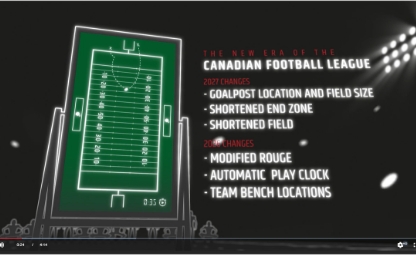
The bigger, 2027 changes reshape the playing surface and goal structure: the field length will shrink from 110 to 100 yards while retaining the 65‑yard width, end zones will be reduced from 20 to 15 yards, and goalposts will move from the goal line to the back of the end zone to open passing lanes and discourage settling for field goals. Alongside safety and officiating clarifications (expanded rough‑play and low‑hit protections and adjustments to ejection/major‑penalty applications), the package is explicitly phased to give teams, officials and stakeholder groups time to adapt while attempting to preserve the core Canadian elements of the game.
There has been some positive feedback from the football community. Many team executives and league officials praise the package as a bold, data‑driven effort to boost scoring and enhance the in‑stadium and broadcast experience, arguing that moving the goalposts and shortening the field will open the middle of the end zone and lead to more touchdowns and higher completion rates in scoring territory. Supporters also note the phased rollout gives clubs time to adapt while early changes like the modified rouge and a standardized 35‑second play clock are expected to speed up game flow and make the product more consistently entertaining for modern audiences.
Players, coaches and broadcasters who favour the changes emphasize improved pacing and viewer experience, saying a faster tempo, clearer substitutions with benches on opposite sidelines, and reduced incentives to settle for field goals will create more dramatic fourth‑quarter moments and highlight offensive skill play. Proponents add that enhanced safety and officiating clarifications—stronger enforcement on low hits and rough play—protect players while preserving distinctly Canadian elements like three downs and the wide field, which helps justify the balance between innovation and tradition.
But there has also been some negative backlash. Many fans, former players and purists reacted angrily, arguing the changes strip away defining features of Canadian football and inch the league toward an Americanized product; critics say shrinking the field, moving the goalposts and limiting the rouge remove plays that produce uniquely Canadian moments and historic game‑changing returns. Social media backlash included petitions, calls to delay the rollout, and vocal condemnations from notable ex‑players and coaches who call the package “disgusting” or a form of cultural vandalism that risks alienating the league’s core supporters.
Practical worries also dominated: amateur and university programs fear costly facility changes or inconsistent rules across levels, season‑ticket holders threatened cancellations, and coaches warned that altered field dimensions and special‑teams tweaks will disrupt development pipelines and kicking strategy for years—concerns that league officials and team executives acknowledge even as they defend the phased rollout and its entertainment goals.
The CFL’s phased rule package aims to modernize the product with a gradual timeline for adaptation. Supporters see a chance to attract new audiences and create more dramatic finishes, while critics warn the changes risk eroding distinctive Canadian traditions. The ultimate test will be how fans, coaches, grassroots programs and broadcasters respond once the new rules take hold. If the CFL can maintain its cultural identity while delivering a faster, higher‑scoring spectacle that respects safety and competitive integrity, the new rules may be judged as a winning strategy, otherwise it could be seen as an Americanization of our beloved game.